Solar panel maintenance
Solar panel cleaning on a Cyprus holiday rental
What solar panel cleaning costs on a Cyprus holiday let, when dust and salt actually cost you generation, and how to schedule it around changeover days.
7 min read

Maria runs the data collection behind our solar pages. She checks installer registrations against the electrical contractor register, records quoted system prices, and tracks changes to the grant schemes as they are published.
Published
Cleaning is the only solar maintenance task on a holiday let that pays for itself in the same season you do it, and it is the one most often skipped — because the loss it prevents is invisible. Dirty panels do not fail. They quietly produce less, month after month, while the property is full and the electricity you are not generating is the electricity you are buying at retail rate.
Why rental property is different
On a house you live in, soiling announces itself eventually: you look up, you see the panels, you notice the film. On a let nobody looks at the roof. The cleaners work indoors, the gardener works at ground level, and the owner is often on another island entirely.
Two things make the loss worse on rentals specifically.
The first is the load profile. A let is occupied hardest in exactly the months when soiling is worst — the long dry stretch when rain stops rinsing the glass. That is also when air conditioning, pool pumps and several people's showers push daytime consumption to its annual peak. Every kilowatt-hour you fail to generate in August is bought back at retail rate rather than exported at the lower net metering value, which makes summer soiling the expensive kind.
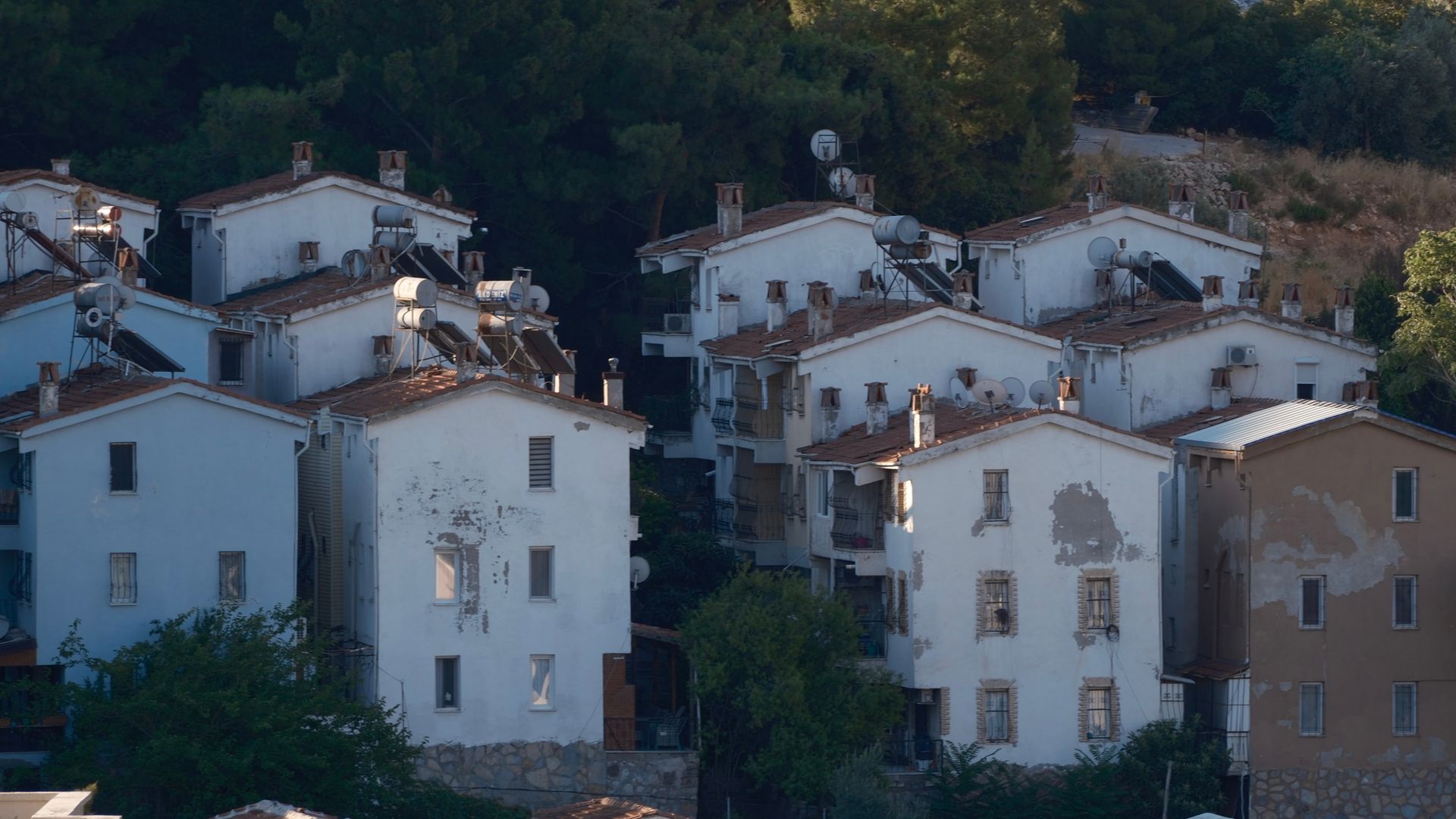
The second is the roof. Cypriot building stock leans heavily on flat or shallow-pitched concrete roofs, and PV on a flat roof sits on a low-tilt frame. Low tilt means water runs off slowly and dust stays put. It also means the array often shares the roof with a solar water heater tank, a satellite dish and an air conditioning condenser, all of which throw shadows and shed grime onto it.
What accumulates varies by where the property is. Along the coast at Kato Paphos, exposure to salt-laden air puts a fine salt film on the glass that binds dust rather than letting it blow off. Inland and near agricultural land it is soil dust, made worse by unpaved access tracks. Island-wide, Saharan dust episodes deposit a reddish layer in a single day, and the rain that sometimes comes with them dries into a crust that a hose will not lift.
Scheduling around bookings
The scheduling calculus is different from most trades because the job is short. A cleaning visit does not need power isolated for hours and does not need the property empty — it needs roof access and an hour or two of cool weather.
That opens up windows that a repair could never use. In Protaras, where holiday lets turn over quickly and the gaps between bookings are short, a cleaning visit fits a changeover morning without touching the guest schedule. In Ayia Napa, where the stock is seasonal tourist accommodation and contractor work concentrates between November and March, the sensible pattern is different: use the off-season for the full service and inspection, and book a lighter clean timed to the start of the season.
A few practical constraints:
Book it cool, not convenient
Cold water on hot glass risks thermal shock, and a panel in Cypriot midday sun is far too hot to work on safely. Cleaning happens early morning or on an overcast day. A contractor who offers you two in the afternoon in July has told you something about how they work.
Check what can reach the property
On hillside plots in Peyia, steep access roads limit the size of vehicle that can get up at all. That matters when the method involves a water tank on a van and a telescopic pole, and it is worth saying on the phone rather than discovering on the day.
Batch the visit
Around Polis Chrysochous, distance from the main Paphos contractor base adds travel time to quoted day rates, so a standalone clean is poor value there. In areas like Aradippou, where the stock is largely newer detached housing and pool work is common, the cheapest clean is usually the one attached to a visit that was already happening.
Add one unscheduled trigger: a significant Saharan dust episode, particularly one followed by light rain. That is the event that justifies a visit outside the plan.
Durability over appearance
The point of cleaning a panel is generation, not looks — and the wrong method costs more than the dirt did.
Three things damage modules. Abrasive pads and stiff brushes scratch the anti-reflective coating on the glass, which permanently reduces output. High-pressure washers force water past the frame seal and into the junction box, which is how a cleaning visit turns into an electrical fault weeks later. And walking on modules to reach the far row causes microcracks in the cells that never show up visually and never come back.
The method that does not do these things is unglamorous: a soft brush, low-pressure water, worked while the glass is cool, and a pole rather than a foot on the panel. Water quality matters more than people expect — Cyprus mains water is hard, and hard water dries into mineral spotting that scatters light almost as effectively as the dust you removed. Deionised or purified water dries clean and needs no drying pass. Detergents are generally unnecessary and some leave a film that attracts dust faster than bare glass.
Ask the contractor to photograph the array before and after, and to note anything they saw up there — a lifted clamp, corrosion on a bracket, a cable resting on hot membrane, a branch that has grown into the shading path. On a coastal roof, salt attacks fixings long before it affects the panels, and the cleaning visit is the only time anyone is close enough to notice.
Cost against nightly rate
Start from the visit price, then set it against what the lost generation costs.
| Work | Indicative range | Midpoint | Published sources |
|---|---|---|---|
| Solar panel maintenanceOne professional cleaning visit to a residential rooftop array under normal roof access; the spread is driven by system size. Cyprus guidance is 2-4 visits per year because of dust, pollen and salt air. A periodic technical inspection is quoted separately at EUR 100-200 every 2-3 years. | €50–€150per cleaning visit | €100 |
Indicative range compiled from published sources, not a quote. It shows the level those sources report for this kind of work, not what your job costs. Only a site visit and a written quote for your actual scope produce a real figure. Sources compiled 2026-08-02.
Those figures are read from the price index when the page loads rather than written into this article, and the price index page carries the breakdown by district and by basis.
What moves the quote:
- Array size and layout. Cost per panel falls sharply with count; a large single-plane array is the cheapest per module to clean.
- Roof access. Ground-level pole access from a flat roof is one price; a pitched roof needing a tower or harness is another.
- Water supply. Whether the contractor brings purified water or works from the property's mains changes both the price and the result.
- Travel. Distance from the contractor's base, which is the dominant factor in outlying areas.
- Whether an inspection is included. A visual and electrical check bundled with the clean costs more and is usually worth it on a property you do not visit.
The comparison that decides it is not the cleaning price against your nightly rate — it is the cleaning price against the electricity bill for the weeks that follow. On a let running air conditioning through the peak, the property's daytime consumption is high enough that almost all generation is self-consumed, so every unit lost to soiling is a unit bought back at retail rate. That is why the same clean is a marginal purchase on an empty second home and an easy one on a property that is full in August.
If you are weighing an annual contract against ad-hoc calls, the contract's real value on a rental is not the discount. It is that someone else is tracking when the visit is due on a property you are not standing in.
Common questions
How often should panels be cleaned on a Cyprus holiday let?
There is no single interval, because the drivers differ by site: tilt angle, how long the property goes without rain, how much dust the surroundings throw up, and how close you are to the sea. A coastal property beside an unpaved track needs more visits than a hillside villa on a steeper frame. Set the first schedule from your own monitoring data, then adjust.
Will rain not clean them for me?
Winter rain does a reasonable job. The problem is the months without it, which are exactly the months your property is earning. Light rain on a dusty panel is actively worse than none, because it lifts dust into droplets that dry into spots and streaks.
Can my cleaning or pool company do it?
They can rinse glass, and for a lightly soiled array on an accessible flat roof that may be enough. What they cannot do is spot a corroded clamp, a degraded cable or a fault in the making. On a property you rarely see, the inspection is the part you are actually buying.
How do I know the clean made a difference?
Compare generation in the week after against the week before, on comparable weather. Better still, compare the month against the same month last year. If your system has monitoring, this takes two minutes; if it does not, that is the first thing to fix on a property you do not live in.
Does cleaning affect the panel warranty?
It can, in both directions. Manufacturers typically exclude damage from abrasive or high-pressure cleaning, and some require evidence that maintenance was carried out. Keep the invoices and the before-and-after photographs, and ask the contractor to confirm in writing that the method complies with the module manufacturer's instructions.
Maintenance contractors
8 companies shown here.
Limassol Electrician 24/7
Germasogeia, Limassol
Limassol Electrician 24/7 is an electrical contractor in Germasogeia, in the Limassol district. Recorded services include fault finding, consumer units, rewiring.
Vascon Solar Experts LTD
Dali, Nicosia
Vascon Solar Experts LTD is an energy supplier in Dali, in the Nicosia district.
- Solar panel installation
- Battery storage
- Solar panel maintenance
Kyriakos Louka & Yioi LTD (Office)
Strovolos, Nicosia
Kyriakos Louka & Yioi LTD (Office) is an electrical contractor in Strovolos, in the Nicosia district. Recorded services include fault finding, consumer units, rewiring.
- 1
KHALIL ABUSHALHA
Larnaca Centre, Larnaca
KHALIL ABUSHALHA is listed on the Cyprus Energy Service register of certified solar PV installers under registration ΕΦΒ/305/2024, valid to 2030-01-12. The entry covers ΛΑΡΝΑΚΑ, the larnaca district. Details come from the public register and have not been verified with the business.
- Solar panel installation
- Solar panel maintenance
- Commercial solar
MARK STUART DAVIES
Paphos Centre, Paphos
MARK STUART DAVIES is listed on the Cyprus Energy Service register of certified solar PV installers under registration ΕΦΒ/71/2020. That registration ran to 2026-02-27 and is not current in the register we hold. The entry covers ΠΑΦΟΣ, the paphos district. Details come from the public register and have not been verified with the business.
- Solar panel installation
- Solar panel maintenance
- Commercial solar
- 1
MOUSSA FAHER
Lakatamia, Nicosia
MOUSSA FAHER is listed on the Cyprus Energy Service register of certified solar PV installers under registration ΕΦΒ/424/2026, valid to 2032-03-04. The entry covers ΛΑΚΑΤΑΜΙΑ, the nicosia district. Details come from the public register and have not been verified with the business.
- Solar panel installation
- Solar panel maintenance
- Commercial solar
- 1
PATRICK MICHAEL MC CLUSKEY
Strovolos, Nicosia
PATRICK MICHAEL MC CLUSKEY is listed on the Cyprus Energy Service register of certified solar PV installers under registration ΕΦΒ/338/2024, valid to 2030-06-21. The entry covers ΣΤΡΟΒΟΛΟΣ, the nicosia district. Details come from the public register and have not been verified with the business.
- Solar panel installation
- Solar panel maintenance
- Commercial solar
STEVEN RUSH
Paralimni, Famagusta
STEVEN RUSH is listed on the Cyprus Energy Service register of certified solar PV installers under registration ΕΦΒ/64/2020. That registration ran to 2025-12-17 and is not current in the register we hold. The entry covers ΠΑΡΑΛΙΜΝΙ, the famagusta district. Details come from the public register and have not been verified with the business.
- Solar panel installation
- Solar panel maintenance
- Commercial solar
Sources
- Cyprus Energy Regulatory Authority — net metering framework — retrieved 2026-07-28
- Electricity Authority of Cyprus — tariffs and supply information — retrieved 2026-07-28
01More on this topic
Same cluster.Different question.
 7 min read
Panel Cleaning Maintenance in Cyprus: What and How Often
What panels in Cyprus actually need, how dust and salt set the cleaning interval, what you can safely do yourself and what has to go to an electrician.
 7 min read
Panel Cleaning in Cyprus: The Questions People Actually Ask
How often solar panels really need cleaning in Cyprus, what moves the price of the visit, and why the summer here makes soiling worse than it looks.
 7 min read
What Solar Panel Cleaning Actually Involves in Cyprus
What a solar panel cleaning visit covers in Cyprus, what pushes the price up, how often the island's dust and salt make it worth doing, and what to check.
Where to go next
Companies, districts and the rest of the guides on this subject.
Thinking of doing this?Get up to five quotes, free.
Send us your roof and your electricity bill and we will gather quotes from installers who work from your numbers.