Solar panel maintenance
Solar panel cleaning in Cyprus: the questions people actually ask
How often solar panels really need cleaning in Cyprus, what moves the price of the visit, and why the summer here makes soiling worse than it looks.
7 min read
Maria runs the data collection behind our solar pages. She checks installer registrations against the electrical contractor register, records quoted system prices, and tracks changes to the grant schemes as they are published.
Published
Cleaning matters more in Cyprus than the equipment manuals suggest, and the reason is not dust. It is the calendar. The lowlands get effectively no rain from June through September, so whatever settles on the glass in May is still there in August — sitting through the four months when the array would otherwise be producing its best output of the year. In a climate with summer rain, the roof washes itself. Here it does not.
The ten questions we get most
- How often do panels actually need cleaning in Cyprus?
- Won't the rain do it for me?
- How much output am I really losing to dirt?
- Can I do it myself with a hose?
- Does it matter what water is used?
- Is there a wrong time of day to clean?
- Is cleaning included in a maintenance contract, or charged separately?
- Do the self-cleaning coatings sold with some panels work?
- What about bird mess and the tree overhanging the roof?
- My panels look filthy after a dust event. Is that an emergency?
Short answers
How often. Twice a year suits most houses on the island: once at the end of spring, after the dust season and before the long dry stretch, and once in autumn. Anything near a main road, a quarry, farmland or a building site needs more. A shaded inland house with a steep array may need less.
Rain. Not in summer, because there isn't any. Worse, the first light rain after a dry spell tends to make things dirtier rather than cleaner — it lands on loose dust, turns it to a film and dries it onto the glass before it can run off.
Losses. Nobody can give you an honest figure without seeing the roof, because soiling loss depends on tilt, what is in the air locally and how long it has been accumulating. What is worth knowing is that the loss is gradual and invisible. You will not notice it happening; you will notice it in the annual production figure if you compare year to year in your inverter's monitoring.
Doing it yourself. On a flat concrete roof with safe access and a system you can shut down properly, brushing with soft bristles and plain water is a reasonable weekend job. On a pitched roof, on a block, or anywhere you would need a ladder against a gutter, it is not — the fall risk is the whole argument, and walking on modules causes cracks in the cells that never show up until output drops.
Water quality. It matters more here than almost anywhere. Cypriot mains water is hard in much of the island and borehole water harder still. Left to dry on hot glass, it leaves mineral spotting that is worse than the dust you removed and that plain water will not take off again. This is why professional outfits use deionised or filtered water through a pole system.
Time of day. Early morning, before the glass heats. Cold water on a panel that has been in full sun for hours is a thermal shock you do not need, and anything you apply at midday in July dries before you can rinse it.
Contracts. It varies by provider, so read what the visit includes. A cleaning call and a maintenance call are different things: one takes soiling off the glass, the other checks connections, isolator condition, mounting fixings and inverter behaviour. Many providers bundle them, and that bundle is usually better value than buying either alone.
Coatings. Hydrophobic coatings shed water and can reduce how firmly dust bonds. They do not remove the need for cleaning, they wear off, and in a salt environment they are working against a harder problem than the marketing assumes.
Birds and trees. Both matter more than general dust, because both create concentrated shading rather than an even film. One heavily fouled cell can pull down a whole string on a basic string inverter, and it also creates a hot spot on the module. Deal with a specific mess promptly; you can wait on the general layer of dust.
After a dust event. Not an emergency, but do not leave it. Saharan dust episodes are heaviest in spring, and the fine reddish deposit they leave is sticky and gets stickier once dew lands on it overnight. Book the clean rather than waiting for rain that will not arrive until October.
Where the answer depends
Two identical arrays a short drive apart can need entirely different cleaning schedules and cost entirely different amounts to service.
| Work | Indicative range | Midpoint | Published sources |
|---|---|---|---|
| Solar panel maintenanceOne professional cleaning visit to a residential rooftop array under normal roof access; the spread is driven by system size. Cyprus guidance is 2-4 visits per year because of dust, pollen and salt air. A periodic technical inspection is quoted separately at EUR 100-200 every 2-3 years. | €50–€150per cleaning visit | €100 |
Indicative range compiled from published sources, not a quote. It shows the level those sources report for this kind of work, not what your job costs. Only a site visit and a written quote for your actual scope produce a real figure. Sources compiled 2026-08-02.
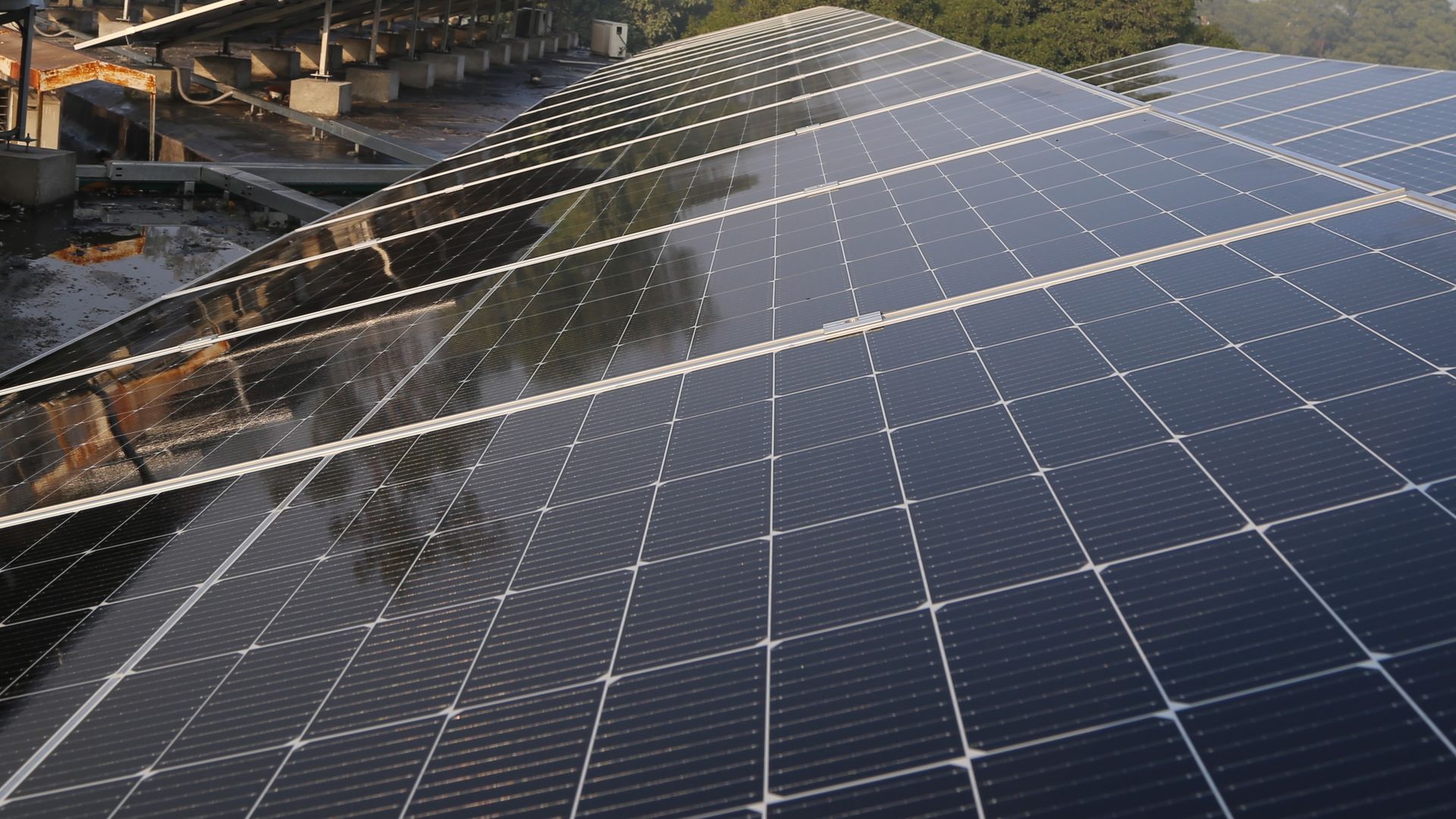
Array tilt. Most Cypriot houses are flat concrete roofs, and on flat roofs panels usually sit on shallow tilt frames to keep wind loading and row spacing manageable. A shallow tilt sheds far less than a steep one. Whatever rain does arrive runs off slowly, and dust stays put. Pitched-roof arrays in the hill villages are self-cleaning in a way that flat-roof arrays here simply are not.
Coastal exposure. Near the sea, and Kato Paphos is the clearest example, the air carries salt. Salt is hygroscopic — it pulls in moisture — so it holds dust against the glass instead of letting it blow off. Coastal roofs need more frequent cleaning than inland roofs with the same dust load.
Overnight humidity. Around Oroklini, proximity to the salt lake raises humidity, and morning dew on a dusty panel does the same thing salt does: turns loose dust into a bonded film. The pattern is the same anywhere the array is damp at dawn.
Access. This is usually what moves the price, not the number of panels. A provider needs to get water and a pole system to the roof. On the hillside plots around Peyia, steep access roads limit vehicle size, and where a tank cannot get close, the job takes longer. Our district pages record where access is the binding constraint.
Use of the property. Holiday lets in Paralimni and Protaras are cleaned to a season rather than to a calendar — before the letting period, not in the middle of it. If nobody is in the house until May, the clean belongs in April.
What nobody asks but should
Is anyone actually reading the output?
Cleaning without monitoring is guesswork. Check your inverter's production for the same month last year before and after a clean. That single comparison tells you whether twice a year is right for your roof, or too much, or not nearly enough.
Is the system shut down before the water goes on?
A proper visit isolates the system first. Ask how they do it. Anyone who turns up and starts spraying a live array with a hose is telling you what else they skip.
Is anything being inspected while they are up there?
Someone is already on the roof with a clear view of the mounting rails, the cable runs and the underside junction boxes. A visit that produces no comment on any of that is half a visit.
What is the roof itself standing on?
Ballasted flat-roof frames sit directly on the waterproofing membrane. Cleaning day is the one visit where somebody has a reason to look at whether the feet have worn through it. That defect costs considerably more to put right than the panels do.
Are the fixings holding up?
Coastal sites need galvanised or marine-grade fixings, and mixed metals on a salt-exposed mounting system corrode faster than owners expect. Rust streaks on the roof surface are the early warning.
Common questions
Is pressure washing ever acceptable?
No. High pressure can force water past the module's edge seal and damage the frame's sealant, and the damage does not appear until moisture has been getting in for a season or two. Soft brush, low pressure, purified water.
Should I clean before or after the summer?
Before. The point of cleaning is to protect the months with the highest production, and those are the months with no rain. A clean in late spring works harder for you than the same clean in September.
How do I compare quotes when providers price differently?
Some price per panel, some per system, some per visit including a maintenance check. Convert everything to a cost per visit for your actual array, then check what each includes. The price pages on this site give current ranges, and the maintenance service pages list providers with their coverage shown.
Maintenance and cleaning providers
8 companies shown here.
Limassol Electrician 24/7
Germasogeia, Limassol
Limassol Electrician 24/7 is an electrical contractor in Germasogeia, in the Limassol district. Recorded services include fault finding, consumer units, rewiring.
Vascon Solar Experts LTD
Dali, Nicosia
Vascon Solar Experts LTD is an energy supplier in Dali, in the Nicosia district.
- Solar panel installation
- Battery storage
- Solar panel maintenance
Kyriakos Louka & Yioi LTD (Office)
Strovolos, Nicosia
Kyriakos Louka & Yioi LTD (Office) is an electrical contractor in Strovolos, in the Nicosia district. Recorded services include fault finding, consumer units, rewiring.
- 1
KHALIL ABUSHALHA
Larnaca Centre, Larnaca
KHALIL ABUSHALHA is listed on the Cyprus Energy Service register of certified solar PV installers under registration ΕΦΒ/305/2024, valid to 2030-01-12. The entry covers ΛΑΡΝΑΚΑ, the larnaca district. Details come from the public register and have not been verified with the business.
- Solar panel installation
- Solar panel maintenance
- Commercial solar
MARK STUART DAVIES
Paphos Centre, Paphos
MARK STUART DAVIES is listed on the Cyprus Energy Service register of certified solar PV installers under registration ΕΦΒ/71/2020. That registration ran to 2026-02-27 and is not current in the register we hold. The entry covers ΠΑΦΟΣ, the paphos district. Details come from the public register and have not been verified with the business.
- Solar panel installation
- Solar panel maintenance
- Commercial solar
- 1
MOUSSA FAHER
Lakatamia, Nicosia
MOUSSA FAHER is listed on the Cyprus Energy Service register of certified solar PV installers under registration ΕΦΒ/424/2026, valid to 2032-03-04. The entry covers ΛΑΚΑΤΑΜΙΑ, the nicosia district. Details come from the public register and have not been verified with the business.
- Solar panel installation
- Solar panel maintenance
- Commercial solar
- 1
PATRICK MICHAEL MC CLUSKEY
Strovolos, Nicosia
PATRICK MICHAEL MC CLUSKEY is listed on the Cyprus Energy Service register of certified solar PV installers under registration ΕΦΒ/338/2024, valid to 2030-06-21. The entry covers ΣΤΡΟΒΟΛΟΣ, the nicosia district. Details come from the public register and have not been verified with the business.
- Solar panel installation
- Solar panel maintenance
- Commercial solar
STEVEN RUSH
Paralimni, Famagusta
STEVEN RUSH is listed on the Cyprus Energy Service register of certified solar PV installers under registration ΕΦΒ/64/2020. That registration ran to 2025-12-17 and is not current in the register we hold. The entry covers ΠΑΡΑΛΙΜΝΙ, the famagusta district. Details come from the public register and have not been verified with the business.
- Solar panel installation
- Solar panel maintenance
- Commercial solar
Sources
- Statistical Service of Cyprus (CYSTAT) — environment and climate statistics — retrieved 2026-07-24
- Electricity Authority of Cyprus — net metering and customer services — retrieved 2026-07-24
- Ministry of Energy, Commerce and Industry — energy policy and support schemes — retrieved 2026-07-24
01More on this topic
Same cluster.Different question.
 7 min read
Panel Cleaning Maintenance in Cyprus: What and How Often
What panels in Cyprus actually need, how dust and salt set the cleaning interval, what you can safely do yourself and what has to go to an electrician.
 7 min read
What Solar Panel Cleaning Actually Involves in Cyprus
What a solar panel cleaning visit covers in Cyprus, what pushes the price up, how often the island's dust and salt make it worth doing, and what to check.
 7 min read
Panel Cleaning for Cyprus Holiday Rentals and Second Homes
What solar panel cleaning costs on a Cyprus holiday let, when dust and salt actually cost you generation, and how to schedule it around changeover days.
Where to go next
Companies, districts and the rest of the guides on this subject.
Thinking of doing this?Get up to five quotes, free.
Send us your roof and your electricity bill and we will gather quotes from installers who work from your numbers.